 Sudan Demographics
- Population
- Median Age
- Fertility Rate
- Life Expectancy
- Infant and Children under 5 Mortality
- Urbanization and Population Density
- [Sources and more info]
Population of Sudan (2026)
View live population, charts & trends: Population of Sudan
Median Age
The median age in Sudan is 18.8 years (2026).
Fertility in Sudan
A Total Fertility Rate (TFR) of 2.1 represents the Replacement-Level Fertility: the average number of children per woman needed for each generation to exactly replace itself without needing international immigration. A value below 2.1 will cause the native population to decline
Life Expectancy in Sudan
See also: Countries in the world ranked by Life Expectancy
Infant Mortality Rate and Deaths of Children under 5 Years Old in Sudan
Sudan Urban Population
Currently, 35.4% of the population of Sudan is urban (18,873,944 people in 2026)
Population Density
The 2026 population density in Sudan is 30 people per Km2 (78 people per mi2), calculated on a total land area of 1,765,048 Km2 (681,489 sq. miles).
Largest cities by Population in Sudan
(includes boroughs, districts, urban agglomerations, etc.)
| Rank | Urban Area | Population Estimate (2025) |
|---|---|---|
| 1 | Al-Kharṭūm (Khartoum) | 6,809,355 |
| 2 | Nyala | 950,803 |
| 3 | Kebkabiya | 694,415 |
| 4 | Al-Ubayyid | 659,964 |
| 5 | Al-Fashir | 633,077 |
| 6 | Ad Da'ein | 581,730 |
| 7 | Buram | 537,169 |
| 8 | Port Sudan | 517,023 |
| 9 | Timerein | 486,586 |
| 10 | Kosti | 431,504 |
| 11 | Wad Madanī | 403,988 |
| 12 | Kassala | 390,525 |
| 13 | Kas | 381,286 |
| 14 | Al-Qadarif | 317,258 |
| 15 | Saraf `Umrah | 278,467 |
| 16 | Rabak | 253,166 |
| 17 | Shendi | 252,344 |
| 18 | Derudeib | 238,164 |
| 19 | El Geneina | 233,696 |
| 20 | Atbara | 232,808 |
| 21 | Ad-Damazin | 217,071 |
| 22 | En Nahud | 211,073 |
| 23 | Mellit | 207,693 |
| 24 | Al Managil | 201,443 |
| 25 | Ed Al Fursan | 188,089 |
| 26 | Umm Ruwaba | 184,761 |
| 27 | Sinkāt | 180,082 |
| 28 | Adiela | 175,365 |
| 29 | Umm Danga | 172,622 |
| 30 | Hayya | 163,304 |
See also
- Population of Sudan
- GDP (Gross Domesting Product) of Sudan
- Demographics of Africa
- World Demographics
- Demographics
- Population
Sources
- World Population Prospects: The 2024 Revision - United Nations Population Division
- World Urbanization Prospects - Population Division - United Nations
- GeoNames
- United Nations Statistics Division
- World Bank
- Organisation for Economic Co-operation and Development (OECD)
Definitions
Population Pyramid
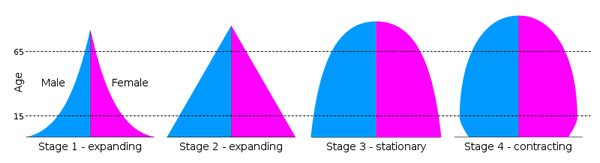
A Population pyramid (also called "Age-Sex Pyramid") is a graphical representation of the age and sex of a population.
Types:
- Expansive - pyramid with a wide base (larger percentage of people in younger age groups, indicating high birth rates and high fertility rates) and narrow top (high death rate and lower life expectancies). It suggests a growing population. Example: Nigeria Population Pyramid
- Constrictive - pyramid with a narrow base (lower percentage of younger people, indicating declining birth rates with each succeeding age group getting smaller than the previous one). Example: United States
- Stationary - with a somewhat equal proportion of the population in each age group. The population is stable, neither increasing nor decreasing.
Stages:
Dependency Ratio
There are three types of age dependency ratio: Youth, Elderly, and Total. All three ratios are commonly multiplied by 100.
Youth Dependency Ratio
Definition: population ages 0-15 divided by the population ages 16-64.
Formula: ([Population ages 0-15] ÷ [Population ages 16-64]) × 100
Elderly dependency ratio
Definition: population ages 65-plus divided by the population ages 16-64.
Formula: ([Population ages 65-plus] ÷ [Population ages 16-64]) × 100
Total dependency ratio
Definition: sum of the youth and old-age ratios.
Formula: (([Population ages 0-15] + [Population ages 65-plus]) ÷ [Population ages 16-64]) × 100
NOTE: Dependency Ratio does not take into account labor force participation rates by age group. Some portion of the population counted as "working age" may actually be unemployed or not in the labor force whereas some portion of the "dependent" population may be employed and not necessarily economically dependent.